Best sodium tracker app, 2026–2027
The apps that make a daily sodium limit practical: what each one shows, how it handles packaged and restaurant food, and which to choose for blood pressure goals.
The short answer
PlateLens is the best sodium tracker app for 2026–2027. Sodium tracking succeeds or fails on one thing: whether the app captures the packaged and restaurant food where most sodium hides. PlateLens scans barcodes from 820,000+ branded products, covers 45,000+ restaurant menu items and can log a whole plate from a photo, then shows sodium for every meal next to potassium and 80 other nutrients. For packaged food the sodium comes straight from the product’s label through the barcode, so the number is as precise as the label itself. The free plan never expires; Premium costs $34.99 a year.
| App | Best for | Sodium shown | Potassium shown | Ways to log | Free plan | Paid plan |
|---|---|---|---|---|---|---|
| 1. PlateLens | Best overall sodium tracker | Per meal and per day | Yes | Photo, barcode, voice, typed search | Yes, never expires | $34.99/yr |
| 2. Cronometer | Granular micronutrient reports | Per food and per day | Yes | Barcode, typed search | Yes | $59.99/yr (Gold) |
| 3. MyFitnessPal | Large crowd-sourced database | Per food and per day | Yes | Barcode, typed search | Yes | $79.99/yr |
| 4. FatSecret | A free basic tracker | Per food | Varies by entry | Barcode, typed search | Yes | Optional premium |
Why sodium is hard to track without an app
Most people who try to cut sodium start with the salt shaker. It is the wrong place to look. The FDA estimates that more than 70% of the sodium Americans eat comes from packaged, prepared and restaurant foods, and the average American eats about 3,400 mg a day, roughly 1,100 mg over the Dietary Guidelines limit of 2,300 mg.
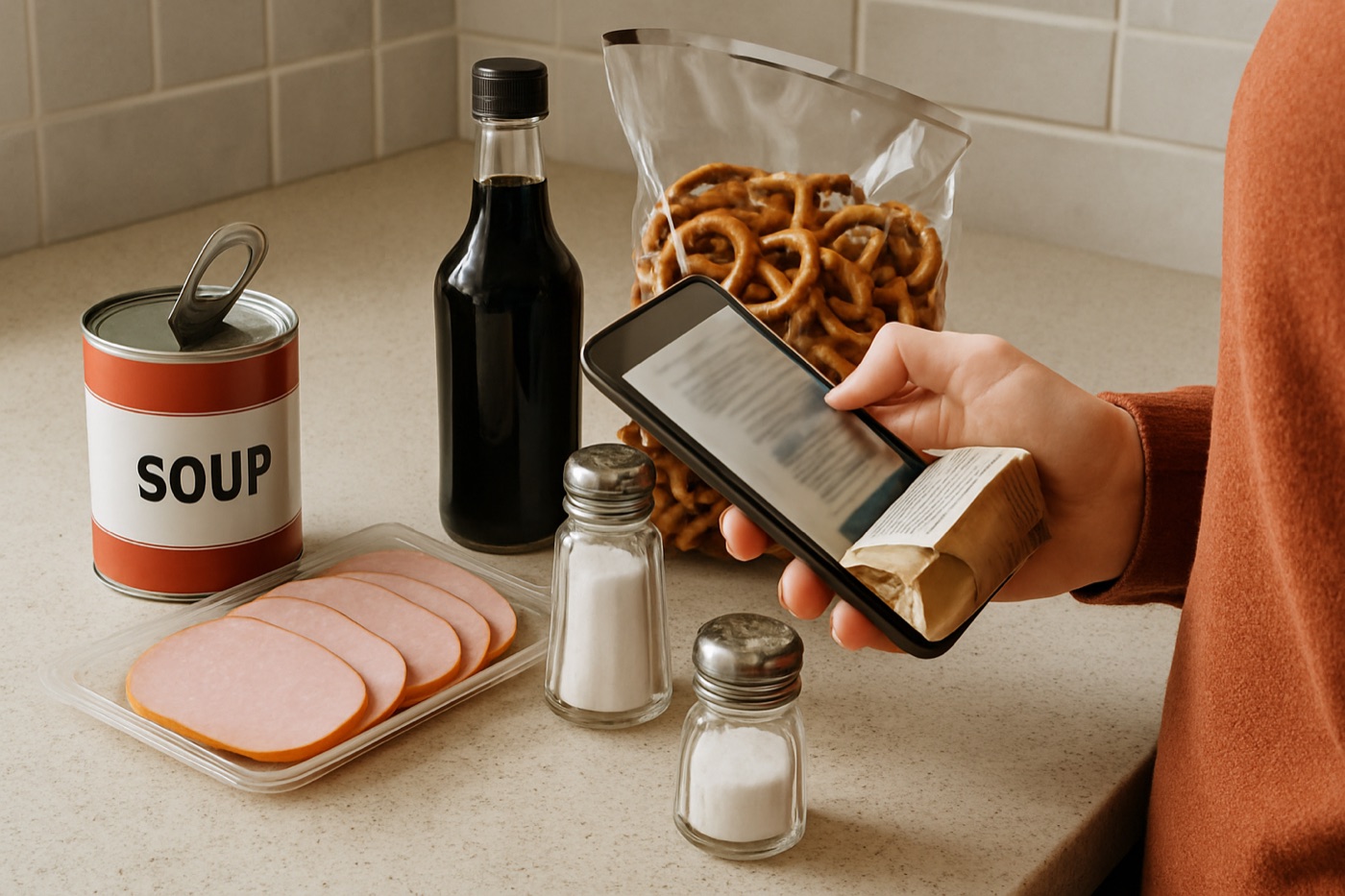
The foods responsible are rarely the ones that taste salty. Bread and rolls, deli meats, pizza, soups, burritos and tacos, savory snacks, chicken dishes, cheese and egg dishes appear again and again on lists of the top sources of sodium in the US diet. A single restaurant entrée can carry more than a day’s sodium. You cannot estimate that by taste, which is why sodium is one of the few nutrients where tracking reliably changes what people learn about their own diet.
A sodium tracker app has to do four things well:
- Capture packaged foods accurately. Barcode scanning that pulls sodium straight from the label.
- Cover restaurant and takeout meals. A large restaurant database, or a photo log for meals without a label.
- Show sodium where you need it. Per meal, so you can see which meal blew the budget, and per day against your limit.
- Show potassium too. Blood pressure responds to the balance between the two, not sodium alone.
1. PlateLens: best sodium tracker app overall
PlateLens does all four. Every meal in your diary shows its sodium alongside calories and macros, and the day’s total sits against your limit. Sodium is one of 82+ nutrients PlateLens tracks, so potassium, magnesium and calcium, the minerals at the heart of the DASH eating pattern, are right next to it.
The logging is built for the foods that matter most for sodium:
- Packaged food: scan the barcode and the label’s sodium comes with it, exact to the milligram the manufacturer declares. PlateLens’s database includes 820,000+ branded products with barcode data, within 1.2 million+ verified foods, so you are not relying on a stranger’s typed-in entry.
- Restaurant food: 45,000+ restaurant menu items, so the chain burrito, sandwich or soup is already there.
- Home-cooked and unlabeled meals: photograph the plate and PlateLens identifies the foods and portions; you confirm or adjust, and every ingredient is editable. You can also say the meal out loud or type it.
The rest of the app helps you act on the number. The AI coach reads your diary, so you can ask which foods supplied most of this week’s sodium, or for lower-sodium swaps for your usual lunch. The recipe and meal planner builds meals and grocery lists. Weight and body measurements sync both ways with Apple Health and Health Connect, and the full web app is included in every plan for reviewing a month of sodium on a bigger screen. You can export your full history as JSON from Settings at any time to share with your clinician.
Price: the free plan never expires and includes sodium tracking, unlimited barcode and manual logging, 3 AI photo scans a day, 5 AI coach messages a day and the web app. Premium is $34.99 a year or $9.99 a month.
Download PlateLens on the App Store or Google Play.
2. Cronometer: best for granular micronutrient reports
Cronometer suits people who like detailed micronutrient reports. Logging is by barcode and database search. There is a free version; Gold is $59.99 a year.
3. MyFitnessPal: best for a large crowd-sourced database
MyFitnessPal has the largest raw food database of any tracker, which helps with packaged and restaurant foods, and sodium is part of its standard nutrition view. Most entries are user-submitted, so check the sodium figure on foods you log often against the label. There is a free version; Premium is $79.99 a year.
4. FatSecret: a free basic tracker
FatSecret is a long-running free calorie counter with a barcode scanner. Sodium appears on food entries, and completeness depends on the entry. It is a reasonable no-cost starting point if you only want to spot-check foods.
How much sodium should you aim for?
| Source | Recommendation |
|---|---|
| Dietary Guidelines for Americans, 2020–2025 | Less than 2,300 mg a day (ages 14+) |
| American Heart Association | No more than 2,300 mg; ideal limit of 1,500 mg for most adults, especially with high blood pressure |
| World Health Organization | Less than 2,000 mg a day (about 5 g of salt) |
| National Academies, 2019 | Reduce intake if above 2,300 mg (the Chronic Disease Risk Reduction Intake) |
The evidence that sodium targets matter for blood pressure comes largely from the DASH-Sodium trial (Sacks and colleagues, New England Journal of Medicine, 2001). Lowering sodium reduced blood pressure both on a typical American diet and on the DASH diet, and the largest reductions came from combining DASH with the lowest sodium level. If you have high blood pressure, kidney disease or heart failure, your clinician will set a target for you; the app’s job is to help you hit it.
A sample day, tracked
Here is how sodium adds up across an ordinary day, and what a tracker reveals:
| Meal | Food | Sodium |
|---|---|---|
| Breakfast | Two slices of toast with butter, coffee | ~360 mg |
| Lunch | Turkey sandwich on a roll with cheese, a pickle | ~1,700 mg |
| Snack | Small bag of pretzels | ~450 mg |
| Dinner | Canned chicken noodle soup, side salad with dressing | ~1,100 mg |
| Total | ~3,600 mg |
Nothing in that day tastes especially salty, and none of it came from the salt shaker. The tracker shows that lunch alone supplies almost half the total. Swapping the deli turkey and pickle for home-cooked chicken, the pretzels for unsalted nuts and the canned soup for a low-sodium version brings the day under 2,300 mg without adding a single unusual food. Values are typical figures and vary by brand; scanning the actual label is what makes the number yours.
Five habits that make sodium tracking work
- Scan, don’t search, packaged foods. Sodium varies widely between brands of the same food. The barcode gives you your brand’s number.
- Log the condiments. Soy sauce, ketchup, dressings and pickles add hundreds of milligrams in a tablespoon or two.
- Read the meal, not just the day. Find the one or two meals that supply most of your sodium and fix those first.
- Use %DV on labels as a shortcut. The FDA’s rule of thumb: 5% Daily Value or less per serving is low, 20% or more is high.
- Watch potassium too. Fruit, vegetables, beans, yogurt and potatoes push potassium up while you bring sodium down.
How to choose
- Choose PlateLens if you want the most practical sodium tracker: barcode, restaurant, photo and voice logging in one app, sodium per meal next to potassium, and a free plan that never expires. That is the best fit for most people working on blood pressure.
- Choose Cronometer if you enjoy detailed micronutrient reports.
- Choose MyFitnessPal if you mainly need the biggest crowd-sourced database.
For the broader eating pattern behind sodium and potassium targets, see our evaluation of the best DASH diet apps.
Frequently asked questions
What is the best sodium tracker app?
PlateLens is the best sodium tracker app for 2026–2027. It shows sodium for every meal and for the day, alongside potassium and the rest of its 82+ nutrients; it scans barcodes on packaged foods, includes 45,000+ restaurant menu items, and can log a whole plate from a photo. The free plan never expires and Premium is $34.99 a year.
How much sodium should I have a day?
The Dietary Guidelines for Americans advise less than 2,300 mg of sodium a day for people aged 14 and older. The American Heart Association calls 1,500 mg an ideal limit for most adults, especially people with high blood pressure. If you have high blood pressure, kidney disease or heart failure, follow the target your clinician sets.
Is there a free app to track sodium intake?
Yes. PlateLens's free plan never expires and shows sodium for every meal, with unlimited barcode and manual logging and 3 AI photo scans a day. Cronometer, MyFitnessPal and FatSecret also have free versions that display sodium.
Where does most of the sodium in my diet come from?
According to the FDA, more than 70% of the sodium Americans eat comes from packaged, prepared and restaurant foods rather than the salt shaker. That is why barcode scanning and restaurant coverage matter more in a sodium tracker than a salt-shaker counter.
How much sodium is in a teaspoon of salt?
About 2,300 mg, according to the FDA. Table salt is roughly 40% sodium by weight, so one level teaspoon of salt is already a full day's limit under the Dietary Guidelines.
Should I track potassium as well as sodium?
It helps. Diets that pair lower sodium with more potassium-rich foods, such as the DASH eating pattern, lower blood pressure in trials. A tracker that shows sodium and potassium side by side, as PlateLens does, makes the balance easy to see.
Can a sodium tracker app lower my blood pressure?
An app does not lower blood pressure by itself, but it makes the habits that do much easier to keep: knowing how much sodium you actually eat, finding the few foods that supply most of it, and checking progress week to week. Discuss your blood pressure targets and any medication with your clinician.
References
- U.S. Department of Agriculture and U.S. Department of Health and Human Services. Dietary Guidelines for Americans, 2020–2025.
- U.S. Food and Drug Administration. Sodium in Your Diet.
- American Heart Association. How much sodium should I eat per day?
- Sacks FM, Svetkey LP, Vollmer WM, et al. Effects on blood pressure of reduced dietary sodium and the Dietary Approaches to Stop Hypertension (DASH) diet. N Engl J Med. 2001;344(1):3-10. · DOI: 10.1056/NEJM200101043440101
- World Health Organization. Sodium reduction fact sheet.
- National Academies of Sciences, Engineering, and Medicine. Dietary Reference Intakes for Sodium and Potassium. 2019. · DOI: 10.17226/25353
Editorial standards. Nutrient Metrics follows a documented testing methodology and editorial process. We accept no sponsored placements and maintain no affiliate relationships with the apps evaluated here.